GLZR Group

Business acquisition criteria:
a buy box people can use.

In brief

Business acquisition criteria are the written boundaries and preferences used to decide which companies deserve a closer look. A buy box makes those criteria usable by a search team. It should specify the business activity, geography, financial measure, acquisition purpose, ownership preference, operating requirements and buyer readiness, while showing which facts still need confirmation.

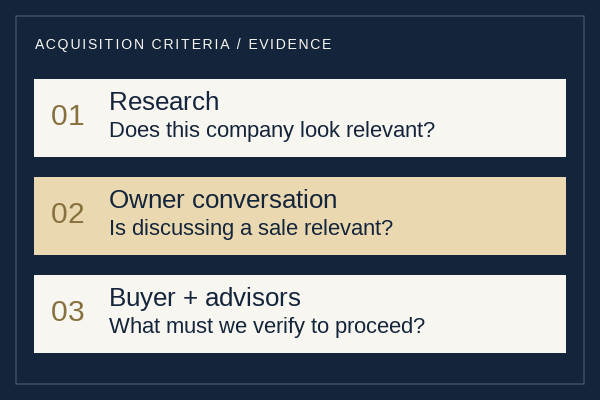
Research screens the company. The owner confirms interest. The buyer and advisors verify the next decision.

. Updated 26 November 2026. Sources checked 26 November 2026.

GLZR perspective

Write a brief that produces the right questions.

GLZR’s perspective starts with a practical question: could two researchers read the brief and build reasonably similar target lists? If one includes distributors and the other includes manufacturers, the brief needs another decision before outreach. The next question is different: what must the owner tell us before this becomes a useful introduction?

This nine-question list is GLZR’s editorial approach to preparing an owner search. It does not set GLZR’s minimum deal size or promise that every requested fact is publicly available. Each buyer chooses its own boundaries. For an initial readiness overview, see preparing to buy a business; this page focuses on the actual search specification.

The acquisition criteria list

Nine decisions before the target list.

Business activity and exclusions

What does the company actually sell, and to whom?

An industry label is a starting point. Specify the activity and customer type, then list nearby business models you would exclude. A search for industrial businesses could include manufacturers, distributors, installation contractors or maintenance providers. Those are different searches.

Research can inspect products, services and customer descriptions. Ask the owner to confirm the actual mix before assuming the website represents the whole business.

Operating geography

Where must the business operate?

Distinguish headquarters, facilities, customer locations and the territory your team can support. A company with a local office may deliver most of its work elsewhere. If you can accept an adjacent region, mark that as a preference rather than letting researchers silently widen the mandate.

Record both the geographic boundary and which location it refers to. Cross-border execution requirements belong with the buyer and its advisors.

Financial measure, period and currency

Which number determines the initial size screen?

Write the measure in full, with a period, currency and the buyer’s chosen range. Revenue, EBITDA and seller’s discretionary earnings answer different questions. Do not use an estimated revenue band as proof of an EBITDA threshold. A database estimate should carry its source date and estimated status.

Initial research can identify possible size fit. Owner-provided figures remain preliminary until the buyer’s financial review reconciles them.

Platform or add-on purpose

What must this acquisition accomplish?

A platform search needs a business that can support the intended operating plan. An add-on search starts with an existing business and a specific reason to combine operations. State whether the acquisition is meant to add a location, capability, customer group or another defined asset.

Describe the operating rationale in one sentence. Link it to a person who can assess it, rather than using a broad promise of growth.

Ownership and control preference

What kind of transaction would you consider?

State whether the search is for a whole business, a controlling interest or another structure the buyer is willing to discuss. If a seller retaining an interest is acceptable, identify it as an option for discussion. Do not imply that a preferred structure is already agreed.

The owner must express willingness to explore the relevant transaction. Advisors assess the rights, documentation and consequences of a proposed structure.

Management and owner responsibilities

Who needs to keep running the business?

Management in place can mean an independent operating team or managers who still depend on the owner for pricing, sales and key decisions. Ask which responsibilities the owner handles, who can take them on and what transition the owner is willing to discuss.

Screen for the required operating coverage. Keep the owner’s description of responsibilities separate from a later assessment of whether the team can carry them.

Customers and revenue model

Which commercial characteristics matter?

Specify the business model you want to explore: contracted work, repeat purchasing, one-off projects or another defined pattern. If customer concentration or a particular customer type is a constraint, write the requirement and the evidence needed to assess it.

A website’s customer logos do not establish revenue concentration or contract terms. Ask for the appropriate information at the agreed stage, under suitable confidentiality arrangements.

Buyer capital and operating capacity

What can your team support now?

Record who is responsible for the funding review, operating plan and professional work needed to evaluate a target. Keep an intention to raise money separate from confirmed availability. A search brief should not describe the buyer as funded merely because possible investors have been identified.

The buyer confirms its own readiness. Financing, affordability and transaction structure need separate review; GLZR does not supply acquisition capital or complete underwriting.

Timing and the next decision

Who can act when an owner responds?

Name the person responsible for reviewing an introduction and the next decision that can actually be made. If an investment committee, board or operating partner must be ready first, record that dependency. A calendar opening is not the same as capacity to progress a suitable opportunity.

Ask about the owner’s timing separately. A good company, an interested owner and a ready buyer are three different conditions.

A worked brief

Replace a broad adjective with a question.

A brief that leaves too much open

“Find an asset-rich business with management in place.”

Does asset-rich mean owned property, equipment or inventory? Does management in place mean a general manager can run the company, or that supervisors remain while the owner still handles sales?

A brief that directs the next step

“Research equipment-based businesses in the agreed region. Separate owned from leased operating assets. Ask which decisions still depend on the owner and who would run daily operations after a transition.”

The first pass identifies possible fits. The owner conversation fills gaps. Financial and legal review tests the underlying claims.

This is a fictional wording exercise, not a prospect case or a recommended investment strategy. The improvement is the specificity of the next question. It still does not prove that any company fits, that assets are available for transfer, or that an owner is willing to sell.

A practical brief builder

Put the search decisions in one place.

Use the nine fields to prepare a discussion brief. Keep confidential names, personal details and transaction documents out of this public-page exercise. A populated field records your instruction; it does not verify financing, company information or owner interest.

Your acquisition search brief

Choose Required, Preference or Undecided for each field. A requirement should reflect a decision the buyer has made, not an attractive adjective. The builder prepares a discussion agenda and records who needs to establish the evidence; it does not score a business.

Specify the activity and exclusions. A broad industry label may cover several different businesses.

Define the operating boundary. Headquarters and customer locations answer different questions.

Name the measure, currency and period. Revenue, EBITDA and SDE are different measures.

Describe the capability and operating responsibility this acquisition should add.

Separate the ownership requirement from the transition arrangement to discuss.

List the duties that must remain with the business, including any owner dependence.

Describe the customer or revenue feature and the records needed to establish it.

Name the funding reviewer and operating lead; record outstanding approvals.

Identify the decision owner and review timetable before arranging introductions.

Your brief will appear here. Blank fields remain undecided; entering text does not verify a claim.

The builder runs in this page. It does not send or save your field values. A download is a plain text file on your device. With JavaScript off, use the nine questions above to write your brief.

For example, a buyer can require operations in a specific region while treating a particular revenue model as a preference. If management continuity is still undecided, record that uncertainty and ask which duties depend on the owner. These are different instructions for a sourcing team. Filling all nine fields does not resolve those trade-offs.

What happens after screening

A search specification is not verified deal evidence.

Public research can often establish what a company says it does and where it operates. It can also reveal information gaps. The owner conversation is where you ask about current responsibilities, timing and whether discussing a sale is relevant. The buyer’s advisors then review the evidence appropriate to a transaction.

For a U.S. business purchase, the SBA recommends considering both the resources needed to purchase and manage the business and professional help from an attorney and accountant. That supports keeping search preparation and transaction review distinct.

U.S. background guidance: SBA: Plan your business, buying an existing business. Checked 26 November 2026.

Maintain a dated version of the brief. If the buyer changes its geographic boundary or operating requirement, record the decision and revisit the affected targets. A previously declined company may now fit, while a company already in the pipeline may no longer meet the brief. Changes should be visible to the people doing the research and speaking with owners.

Your next step

Bring a clearer brief to the first call.

GLZR translates the buyer’s acquisition criteria into targeted owner campaigns and gathers initial information before introductions. A useful first discussion covers the business you want, the search coverage you already have and what makes an introduction qualified for you. See how to size a target market and how sourcing channels contribute different coverage.

The free proof of concept ends after 3 qualified meetings are held or 30 days, whichever comes first. Trial meetings remain free; paid continuation is agreed in writing. Read the current terms and qualification details.

Questions

Questions about acquisition criteria.

What should business acquisition criteria include?

Include business activity and exclusions, operating geography, the financial measure and period, platform or add-on purpose, ownership preference, management requirements, customer and revenue model, buyer capacity, and timing with a named decision owner.

What is an acquisition buy box?

An acquisition buy box is a written search brief that makes a buyer’s acquisition criteria usable for screening companies. It should distinguish firm boundaries, preferences and information still to be confirmed.

Does a company matching the buy box mean its owner wants to sell?

No. Company fit and owner interest are separate. Contact the appropriate owner, ask whether a sale discussion is relevant and record the answer without treating silence or general curiosity as sale intent.

Can acquisition criteria change during a search?

Yes. Record the change, the decision maker and its effective date, then review affected targets against the revised brief. Keep the previous version so your team can explain why earlier screening decisions differed.

Should every acquisition criterion be a requirement?

Choose deliberately. A requirement is a boundary the buyer intends to enforce; a preference allows a trade-off; an undecided item needs a decision before it guides screening. Preserve the reason for the choice and the evidence still needed. This builder does not rank investments or verify a buyer mandate.

What should I take from an acquisition brief into an owner call?

Bring the relevant criteria, the facts still missing and specific questions about the business and the owner's role or interest. The builder exports a field-by-field agenda and identifies which evidence belongs to research, an owner conversation or buyer/advisor review. Keep funding and internal decision responsibilities with the buyer.