GLZR Group

Proprietary deal sourcing:
seven checks before the call.

In brief

Proprietary deal sourcing aims to find acquisition opportunities through a buyer's research, relationships or direct owner outreach. It does not, by itself, establish that the business is off-market, that other buyers are absent or that the owner wants to sell. Check the sourcing route, current process and owner response separately.

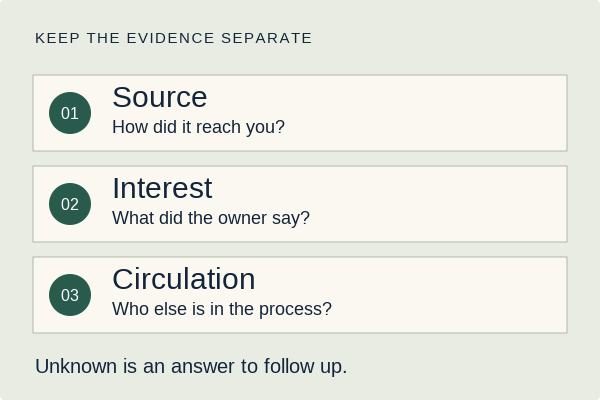
Source, current marketing and owner interest answer different questions.

. Updated 25 November 2026. Sources checked 25 November 2026.

What the term tells you

A label is a starting point.

Your banker may know an owner. So may another buyer's accountant. The referral can be valuable without giving you exclusive access. The question is what your team knows about this particular business and its current sale process.

Direct access describes the route. Limited competition needs its own evidence.

The distinction also matters in research. In their 2015 study, Paul Gompers, Steven Kaplan and Vladimir Mukharlyamov reported private equity investors' descriptions of proprietary deals but said they could not evaluate exactly what proprietary meant to those investors. A self-reported sourcing label is not a verified measure of exclusivity.

Source: What Do Private Equity Firms Say They Do?, NBER Working Paper 21133, section 6.1, pages 25–26. Checked 25 November 2026. Historical survey context, not evidence of today's deal prices.

The following seven checks are GLZR's editorial framework for organizing initial sourcing information. They do not certify a deal, replace due diligence or interpret an exclusivity agreement.

The list

Seven checks for a proprietary introduction.

Trace the introduction back to its source.

How did this company enter our pipeline, and who has spoken with the owner?

A banker referral, a direct reply and a company found in a database describe different events. Keep the chain intact: who identified the business, who made contact and who passed it to you. A warm introduction may be useful even when it is not unique to your firm.

Record: Record the source, the date and the person who can explain the introduction. Avoid labelling every new CRM record proprietary.

Ask whether there is an active sale process.

Is the owner currently marketing the business, using an advisor or working toward an offer deadline?

An unlisted website does not establish that a business is off-market. A company can be discussed privately with several buyers without a public listing. Ask the owner or the authorized intermediary about current marketing rather than inferring it from a search result.

Record: Record the answer and who gave it. Separate confirmed facts from what has not been checked.

Separate direct access from limited competition.

Is this a one-buyer conversation, or are other buyers being approached?

Direct contact describes the route to the owner. It does not tell you how many other conversations the owner is having. The owner may choose not to name those buyers; you can still ask about the process, its breadth and whether there is a common deadline.

Record: Record the reported extent of the process without demanding other buyers' confidential identities. An unknown answer stays unknown.

Capture what the owner is open to discussing.

Are you open to discussing a sale, seeking information, or simply agreeing to an introductory conversation?

A company that fits the investment thesis is a research target. An owner who agrees to hear about the buyer has expressed a narrower form of interest than an owner considering a transaction. Preserve that distinction in the brief instead of turning every positive reply into a ready seller.

Record: Include the owner's actual response, the context and the date. Summarize it faithfully; do not strengthen the wording.

Check the criteria that would change the buyer's decision.

Which acquisition criteria are supported, and which still need an answer?

Use the buyer's stated criteria, such as industry, location, size, assets and management requirements. Mark the basis of each answer: a public record, company material, an owner statement or an estimate. Initial screening can identify a potential fit; it does not independently verify financial statements.

Record: Keep confirmed information, owner-reported information and open questions in separate fields. A precise-looking revenue estimate does not settle an EBITDA requirement.

Confirm what can be shared and with whom.

What information has the owner authorized us to pass on, and what needs to wait?

An owner may be willing to speak without being ready to circulate a name, customer list or detailed accounts. Establish the next permitted introduction and the information needed for it. Keep confidentiality arrangements separate from any claim of exclusivity; your advisors should review the applicable agreements.

Record: Record the agreed sharing scope and the person responsible for the introduction. Do not put sensitive owner details in a public sourcing list.

Give the evidence a date and the conversation a next step.

When was this status checked, and what has each side agreed to do next?

A conversation that was off-market last month may now have an advisor and a timetable. Refresh the process status before relying on it. The next step might be an introductory call, permission to share a short profile or a follow-up at a time the owner selected.

Record: Keep a last-checked date, the specific next action and its owner. Recheck when the process changes rather than treating the original label as permanent.

Keep unknowns visible

What do your answers establish?

Use the answers you have actually established. This exercise keeps owner interest separate from the marketing process and other buyer involvement. It does not infer missing answers or certify exclusivity.

Select what you have established. Unknown answers stay unknown; this tool does not certify exclusivity.

Runs in this page. No names, deal details or answers are submitted or saved by this exercise. With JavaScript off, use the seven checks above.

Download the seven-check evidence log (CSV). The evidence, source and date fields are blank for your own review.

Worked example

A better brief changes the next question.

Illustrative example: the company fits, but the process is unclear.

A buyer wants an asset-rich business with at least $3 million in EBITDA and a management team in place. A referral describes a suitable company. The owner says, “I would hear more about your approach.” No one has asked about current marketing or other buyers.

The brief should say: potential fit based on initial information; owner open to an introductory discussion; sale interest and process breadth still to be established. It should not say: verified financial fit, ready seller or exclusive deal.

The next conversation can ask whether a sale is under consideration, which criteria the owner can address now, and what information may be shared. Keep the answer in the owner's terms.

This is a fictional illustration, not a GLZR transaction or client result. The point is the separation of evidence: financial screening, willingness to discuss and sale-process status do not answer one another.

From criteria to a conversation

Use outreach to learn what a database cannot confirm.

A targeted owner campaign starts with the buyer's criteria and a relevant group of companies. Research helps identify potential fits. Contact and follow-up establish whether a particular owner will discuss a sale and what can happen next.

Professional networks remain useful. A buyer can retain banker and broker relationships while adding direct outreach. The aim is to expand relevant coverage and establish owner interest, not to assume that every direct approach avoids competition.

Compare who does each part of the work in the deal sourcing company and platform shortlist. Keep pipeline stages tied to evidence, so a research target is not counted as an owner introduction.

Questions

Questions about proprietary deal flow.

What is proprietary deal sourcing?

Proprietary deal sourcing is an attempt to originate acquisition opportunities through a buyer's own research, relationships or direct outreach rather than relying only on a broadly marketed sale process. The label alone does not prove that other buyers are absent.

What is the difference between off-market and proprietary deal flow?

Off-market describes how a business is being offered at the time checked. Proprietary usually describes how the opportunity was originated or the access a buyer believes it has. Usage varies, so record the actual sourcing route, marketing status and owner response.

Does a direct owner introduction guarantee a lower purchase price?

No. Direct access alone does not establish a discount, an agreed valuation or a completed deal. Evaluate the business and transaction on their own evidence.

Can a broker introduce an off-market business?

An intermediary can arrange a private introduction. That does not establish how widely the business is being discussed. Ask what the owner has authorized and whether other buyers are part of the current process.

What should a qualified owner introduction include?

Agree the definition with the sourcing provider. A useful brief distinguishes the business criteria, the basis for the initial fit, the owner's actual response, permitted information sharing and the next agreed step.

Your search

Build the search around your acquisition criteria.

GLZR Group builds targeted campaigns around a buyer's acquisition criteria, contacts owners and gathers initial information before an introduction. It does not complete formal valuation, due diligence, financing or closing. Those remain with the parties and their advisors.

Read how GLZR approaches deal sourcing, then agree the initial qualification and introduction requirements for your search.

Discuss your acquisition criteria

Email GLZR about your acquisition search