GLZR Group

Mechanic shop valuation calculator.
See what sits behind the price.

In brief

This mechanic shop valuation calculator applies published US auto repair and service sale multiples to annual seller’s discretionary earnings (SDE). Enter your SDE and an optional asking price to compare three benchmark scenarios. GLZR Group connects business owners and buyers; the results are not a formal valuation or an offer for your shop.

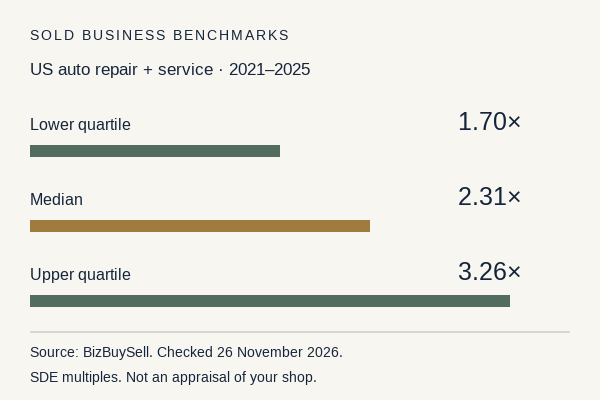
US auto repair and service sold-business SDE multiples: lower quartile 1.70, median 2.31, upper quartile 3.26; 2021–2025 BizBuySell data.
Historical sold-business multiples from BizBuySell, not current asking-price multiples. The category includes specialist auto service shops.

. Updated 26 November 2026. Benchmark source checked 26 November 2026.

The calculator

What could your mechanic shop be worth?

Enter a full year’s SDE in US dollars. If you have revenue, EBITDA or an unadjusted bank balance instead, stop here and establish the correct earnings measure with your accountant. For help organizing the inputs, see the SDE explanation and general business valuation calculator.

Your auto repair shop scenarios

The starting figures are fictional: $200,000 annual SDE and a $500,000 asking price. Replace them with your own inputs.

Seller’s discretionary earnings. Use one annual period; not revenue or EBITDA.
The price being discussed for the business. Leave blank if undecided.
Benchmark scenarios: $340,000 at 1.70×; $462,000 at 2.31×; $652,000 at 3.26×. Asking price / annual SDE = 2.50×. Within the published quartile range; this does not establish whether the asking price is fair.
1.70× lower quartile
$340,000
2.31× median
$462,000
3.26× upper quartile
$652,000

Calculations run in this browser tab. The tool does not send or save your amounts. Interaction analytics record the action and page, not the inputs. A download saves a text file on your device. Without JavaScript, the worked example remains readable and the inputs are disabled.

Formula: annual SDE × the selected published multiple. Asking-price multiple = asking price ÷ annual SDE. Dollar results are rounded to whole US dollars; the asking-price multiple is rounded to two decimals. The chart uses the same three calculations as the text.

This calculation makes no adjustments for debt, cash, real estate, equipment, inventory, working capital, taxes or transaction costs. It does not calculate owner proceeds, financing capacity or a buyer’s return. Confirm the transaction scope separately before using the result in a negotiation.
Source and method

Published benchmarks. Visible calculations.

The BizBuySell auto repair and service valuation report covers 1,286 reported US sales in its 2021–2025 sample. Its sold-business SDE multiples are 1.70 at the lower quartile, 2.31 at the median and 3.26 at the upper quartile. The category also includes tire, body, glass and other specialist shops; it is not a mechanic-only sample. Checked 26 November 2026.

We use the sold-business series, not the report’s asking-price series. These are historical national benchmarks. The quartiles describe the distribution of reported multiples; they are not a probability interval or a promise that your shop will sell inside this range.

What GLZR calculates

The tool holds your annual earnings constant and applies each benchmark. In the fictional example, $200,000 × 2.31 = $462,000. Separately, a $500,000 asking price divided by $200,000 SDE equals 2.50×. Changing the asking price changes its implied multiple, not the three benchmark scenarios.

What remains to be established

Whether the input earnings are supportable, whether the comparison suits this business and what a specific buyer would offer. There is no automatic bonus for bays, reviews, equipment or owner independence. Those details belong in a documented discussion, not an unexplained score.

GLZR’s owner-introduction perspective

Five questions behind the mechanic shop valuation.

The number is useful when it helps you ask a better question. GLZR’s perspective is that an owner introduction should clarify the business and the intended handover before either side treats a calculated range as an agreed price. Use the following questions to prepare that discussion.

What work does the shop actually do?

Separate general repair, maintenance, diagnostics, tires, body work and any other activity. Describe the mix you have rather than selecting a category because it produces a more attractive estimate. Keep retail customer work and fleet arrangements distinct when explaining the customer base.

Which jobs still depend on you?

List the owner’s role in diagnostics, estimating, service writing, hiring and customer relationships. If you want to step away, explain who currently covers each responsibility and what remains to be arranged. A shop with employees can still depend on the owner for key decisions.

What is included in the proposed sale?

Identify the shop’s equipment, lifts, tools, parts inventory and property separately. Mark items that are leased, owned outside the operating business or owned by someone else. Ask the buyer and your advisors how the intended scope will be reflected in the documents and price.

Which records support the earnings input?

Keep the period, currency and supporting accounts with the calculation. Ask your accountant to explain proposed adjustments and avoid counting the same expense twice. If a figure is provisional, label it that way instead of making the calculator output appear more certain than the input.

What transition do you want?

Describe your preferred timing and whether you would consider remaining for an agreed period. Keep preferences distinct from commitments. A buyer’s operating plan and your intended exit may differ even when both sides are comfortable discussing the price.

A practical first-call example

Fictional owner: “I want to step back, but I still handle difficult diagnostics and every fleet account.” The follow-up is to clarify those responsibilities and the transition the owner would consider. The calculator cannot answer that question, and it should not assign a price premium or discount because the owner selected a box.

Your next step

Bring the operating picture, as well as the number.

You can start a sale discussion before choosing a final asking price. Bring a short description of the shop, the annual earnings measure you have, the responsibilities you hold and your preferred timing. The downloaded scenarios keep the inputs, arithmetic, source and limits together so the conversation does not rely on a screenshot of one attractive number.

GLZR gathers initial business information and connects owners and buyers where there is a potential fit. The parties and their advisors handle formal valuation, financial verification, due diligence, financing, transaction documents and closing. An initial conversation does not commit you to a sale or establish the terms of an engagement.

For the disclosure questions to discuss before sharing detailed records, read how a confidential business sale starts. For a broader view of the owner’s next steps, see selling a small business.

Questions

Questions about valuing a mechanic shop.

How does this mechanic shop valuation calculator work?

It multiplies annual seller’s discretionary earnings in US dollars by three published historical auto repair and service sale benchmarks. An optional asking price shows its implied SDE multiple. It does not select a valuation multiple for your individual business.

Can I enter revenue or EBITDA instead of SDE?

No. The selected benchmarks use seller’s discretionary earnings. Establish that figure with your accountant before using this calculator. Mixing earnings measures makes the comparison misleading.

Is the result the amount I would receive at closing?

No. The output is a benchmark scenario. It does not adjust for debt, cash, property, inventory, working capital, taxes, transaction costs or payment terms. Ask your advisors to evaluate proceeds using the actual proposed transaction.

Does GLZR provide a formal shop valuation through this tool?

No. The calculator is an educational comparison. GLZR gathers initial information and introduces business buyers and owners where there is a potential fit. Formal valuation and due diligence belong to the parties and their advisors.